When a Landscape Becomes a Point of View
Use close reading to see how Southern film landscapes shape a character’s choices, and distinguish a meaningful visual pattern from mere scenery.
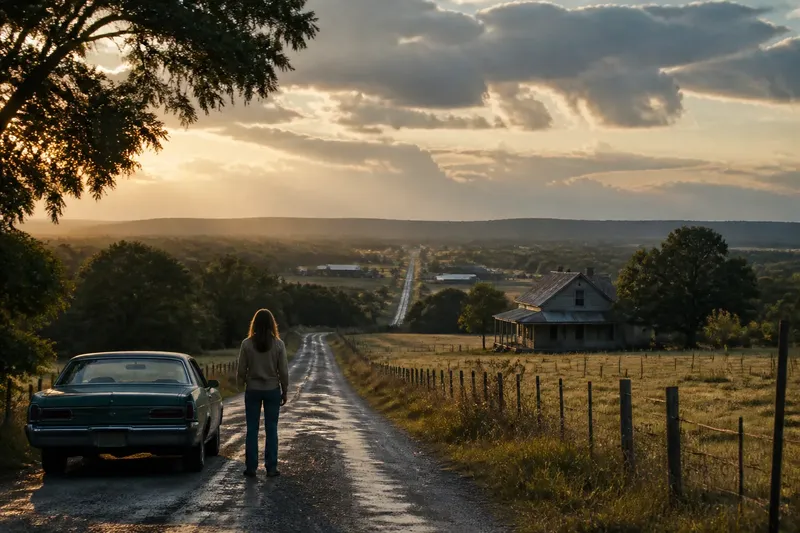
How can you tell whether a Southern film’s landscape is shaping a character’s choices or simply sitting behind the action? In a close reading of film landscape, track what changes in the image when the character acts, hesitates, or gets turned away.
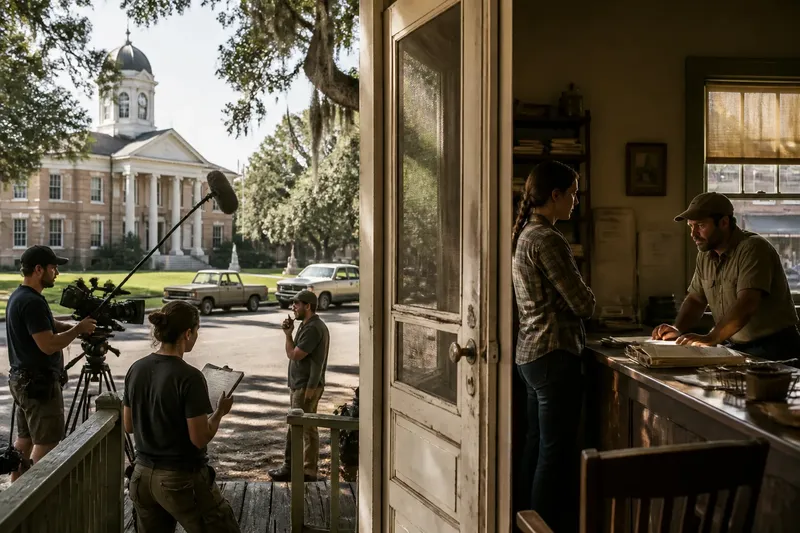
Rather than sorting roads, horizons, and buildings into separate symbols, follow one scene from its first establishing image to its final cut. Note what the camera reveals, what the character does with that view, and which visual details return. A landscape earns interpretive weight through its relationship to the scene—not through a universal meaning attached to a porch, field, or highway.
Start with the scene’s change in pressure
Choose a scene where a character faces a decision, enters a place, or waits for someone. Write down the immediate situation in plain terms: what does the character want, and what prevents them from getting it? This keeps the setting connected to the story’s action.
Then mark the scene’s turning point. It might be a door opening, a vehicle arriving, a character looking away, or a cut from a wide view to a close shot. Compare the landscape before and after that moment. If the view stays unchanged while the character’s behavior shifts, the setting may be a stable backdrop; if the framing or visible boundary changes with the action, the landscape may be participating in the scene’s pressure.
Keep your notes concrete. “The camera holds on the empty doorway after she leaves” is an observation; “the town rejects her” is an interpretation that needs more evidence.
Track what the camera lets the character see
Point of view is not limited to a shot taken through a character’s eyes. It also comes from what the film chooses to show around them: a destination cut off by trees, a road seen only through a windshield, or a room where another person remains just outside the frame.
Record the character’s gaze and the camera’s response. Does the film cut to what they look at, stay on their face, or show a different view? When the character cannot see a place that the audience can, the gap may matter. When the camera withholds the view from both character and audience, uncertainty becomes part of the scene’s form.
For a useful close reading, separate three things: the visible image, the character’s action, and your inference. That distinction makes it easier to revise an interpretation when a later shot complicates it.
Read repeated details as a visual pattern
A fence, sign, tree line, or empty chair gains significance when the film returns to it in a changed context. Note the first appearance, the later return, and what has changed in the character’s relation to it. A repeated object need not be a symbol; it may simply help the film orient the viewer or mark a transition.
Ask whether the camera gives the detail emphasis. A lingering shot, a shift in focus, or a cut that links the detail to a character’s reaction can support an interpretation. A background feature that never affects the composition or action may not deserve much weight.
Use the film’s own pattern as your evidence, rather than importing a fixed meaning from outside it.
Check whether sound changes the landscape
Listen for sounds that connect a location to life beyond the frame: traffic, machinery, insects, music from another room, or voices carried from a nearby gathering. Notice whether the sound begins before the image changes, continues after a cut, or disappears when the character crosses a threshold.
Sound can make a quiet image feel occupied or turn a familiar place strange. It can also contradict what the picture suggests: a broad, open view paired with an enclosed interior sound may make the scene feel less free than it looks. Describe the sound first, then explain how its timing affects your reading.
When sound and image disagree, preserve the disagreement in your interpretation instead of forcing them into one message.
How do you turn observations into a close reading?
What should you write down while watching?
Note the shot change, a character’s action or gaze, and one detail of the setting that the camera emphasizes. Add a brief sound note if it changes across the scene. These observations give you material to interpret without relying on memory alone.
How many details support an interpretation?
Look for more than one cue, such as a repeated framing choice and a character’s response. If the details point in different directions, state that tension rather than treating one cue as decisive.
What if the landscape seems unrelated to the action?
Describe what is visible and check whether the scene returns to it or changes its framing. If no connection develops, it is reasonable to read the landscape as setting rather than assign it a symbolic role.
How can you avoid treating one image as the whole South?
Keep your claim attached to the film and scene you are discussing. A particular road, building, or field reflects a chosen view of a specific place, not a complete account of the region or its residents.
Use a short evidence check before settling on a reading
For each scene, make a compact record of what you observed and decide what that observation permits you to claim. If a detail does not recur, affect an action, or receive emphasis through framing or sound, use it cautiously.
- Observation: the camera holds on a road after the character’s car exits. If the pause follows a stated decision to leave, connect the road to departure; if the scene gives no such context, describe the lingering road without calling it an escape.
- Observation: the character looks toward a distant ridge, but the film does not cut to the view. If the character’s expression or later action changes, consider the unseen view relevant; if nothing responds to the gaze, treat the ridge as background.
- Observation: a fence appears in two scenes with different framing. If the later shot blocks the character’s path, discuss the boundary as part of the action; if the fence remains incidental, avoid claiming it represents exclusion.
- Observation: traffic noise continues after the image moves indoors. If the character pauses or reacts, connect the sound to the scene’s sense of exposure; if no reaction or pattern follows, note it as ambient sound.
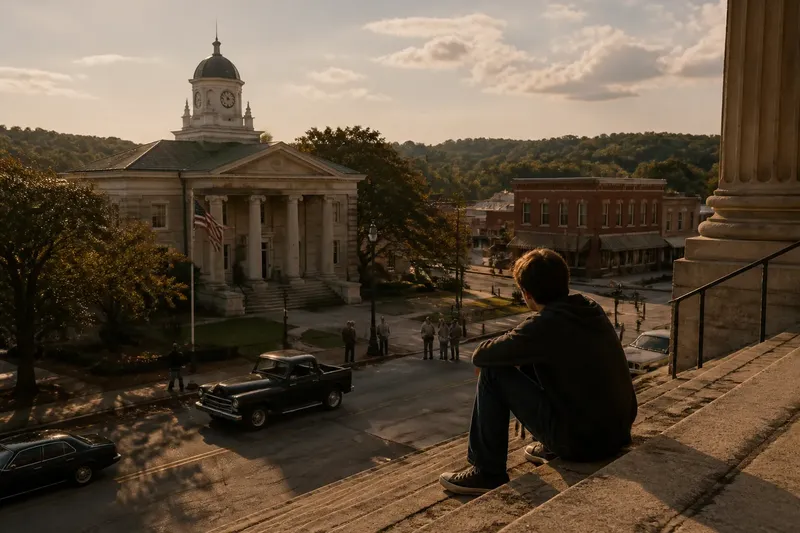
- Observation: one character enters a public building while another waits outside. If the film shows a reason for the difference, describe that specific access; if it does not, do not infer a broad social rule from the single contrast.
- Observation: an empty chair remains in frame after a person leaves. If the film returns to the chair or another character notices it, consider absence as part of the scene; if not, describe the shot without assigning the chair a fixed meaning.
Say you are reading an invented scene in which a character reaches a locked community hall after a late shift. The starting observations are a wide shot of the parking area, a locked door, a fluorescent light visible through a side window, and a faint radio sound from inside. First, note that the character tries the handle and waits; that establishes an immediate obstacle. Next, note that the camera stays outside rather than cutting to the lit room; the character and viewer share limited access. Then listen for the radio: because it continues while the character stands at the door, the building seems occupied even though entry is denied. The resulting reading is narrow and supportable: this scene makes access to this particular gathering feel uncertain. If the film later shows the character entering freely, revise the claim to a temporary delay; if the door remains closed and the character leaves, the scene gives stronger evidence of exclusion. Neither result alone proves how the entire community works.
Keep the interpretation tied to the frame
When you write about landscape, pair each claim with an observable choice: where the camera stands, what enters or leaves the frame, how the character responds, or when a sound carries across a cut. This gives readers a way to follow your reasoning and keeps the interpretation open to revision.
Close reading film landscape works best when it preserves the difference between a place and the film’s view of that place. Describe what the scene shows, identify how its form guides attention, and limit the conclusion to what the evidence can bear. The most useful final question is often simple: what does this character experience here that the frame allows us to see?