The One-Story South: Why a Familiar Film Image Is Not the Whole Region
Use a scene-by-scene method to read a familiar image in Southern films, see how it shapes the story, and keep your conclusions tied to the film.

What does a familiar Southern film image actually do in the story? A close reading of Southern films can answer that by tracing one recurring detail—such as a courthouse, a family gathering, or a small-town official—through the film’s scene order and changes in context.
Choose an image that recurs in the film
Select one film and one image that appears more than once or anchors a key scene. Keep the focus narrow: a porch, a church supper, a family business, or a character introduced through a regional manner can all work.
Write a neutral description of the image and note the scenes where it appears. Record what changes from one appearance to the next: who is present, what is happening, and whether the scene’s mood shifts. Hold off on labels such as “authentic” or “stereotyped” until you have compared those appearances.
Use a scene list or simple table in a notebook or spreadsheet. The goal is to track how the image changes the film’s setting and story, not to make a verdict about the whole region.
Read the image through its changing context
For each appearance, note the immediate story function. Does the image establish where a scene takes place, create a meeting point, interrupt an argument, or connect separate parts of the plot? Then compare its use across scenes rather than treating every appearance as the same signal.
Pay attention to the film’s sequence. An image introduced as ordinary background may become charged after a conflict; a location that first seems welcoming may later be associated with exclusion or loss. Describe the change in the film’s own terms, using what happens before and after the scene.
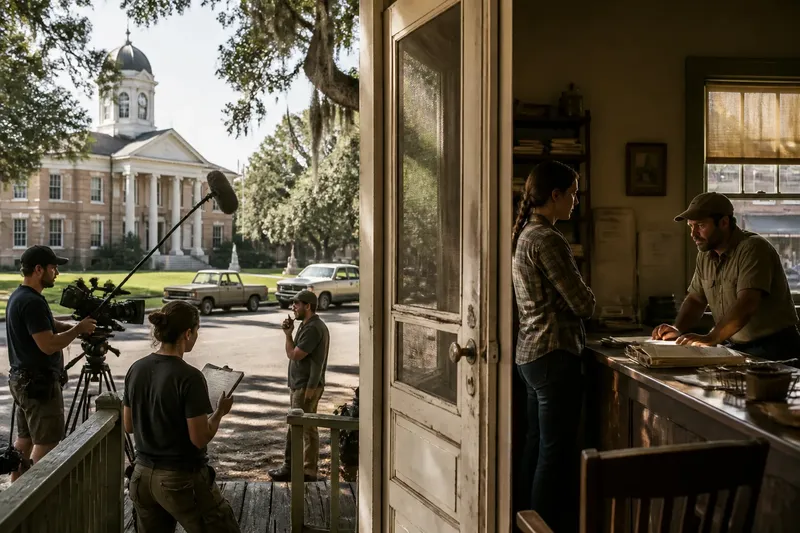
Imagine an invented film that shows a courthouse first as a town landmark, then as the setting for a family dispute, and finally as a place a young character avoids. A scene list would show the building shifting from orientation to conflict to personal reluctance. That reading stays grounded in the film’s sequence rather than treating the courthouse as a fixed symbol.
Separate recurring details from the film’s pattern
A single image can carry several functions, but repetition alone does not prove a larger claim. Check whether the film returns to the image in similar circumstances or changes its use. Look at the scene’s practical job, its placement in the plot, and what the audience knows by that point.
Use this checklist for each appearance. Every observation should lead to a decision about how to describe the pattern:
- Check whether the image appears in a new plot situation; if its function changes, describe the shift, and if it repeats the same function, call it a recurring pattern.
- Check whether the scene introduces a place or relationship the audience needs to understand; if it does, describe the image as orientation, and if it does not, look for another story function.
- Check whether a later scene changes the meaning of an earlier appearance; if it does, connect the scenes, and if it does not, avoid claiming a transformation.
- Check whether the image appears during a decision or conflict; if it does, explain how it frames that moment, and if it does not, treat it as setting unless other scenes suggest more.
- Check whether the film repeats the image without adding new information; if it does, describe the repetition as emphasis, and if each return adds context, explain the accumulating pattern.
- Check whether your interpretation depends on details visible or audible in the scene; if it does, cite those details in your notes, and if it does not, narrow the claim to what the film actually presents.
These checks help distinguish a film’s repeated visual or narrative choice from an assumption imported by the viewer.
Questions that clarify how an image works?
How many appearances should I compare?
Compare the appearances that help explain the image’s role, including any that seem to contradict one another. If it appears only once, analyze that scene’s placement and function rather than describing a recurring pattern.
Should I treat a location as a symbol?
Start by describing its concrete use in the scene, such as a place to meet, work, wait, or argue. Call it symbolic only when repeated details in the film support that interpretation.
How do I handle an image whose meaning changes?
State what it does in each relevant scene and identify the event or new information that changes its effect. If the film leaves the relationship uncertain, describe the contrast without forcing a single meaning.
Can two readings of the same image both fit?
Yes, if each reading accounts for specific scenes and neither ignores details that complicate it. Explain where the interpretations diverge and what evidence each one uses.
Write an interpretation tied to the scene sequence
Build a short paragraph from three parts: identify the image, describe how its use changes or repeats, and explain what that pattern does for the story. Refer to concrete details such as scene order, dialogue, action, or the image’s placement in the film.
For example, in the invented courthouse film, the viewer’s notes list three appearances: the building introduces the town, hosts a family dispute, and appears again when a young character avoids going inside. The writer can then say the film uses the courthouse to connect public authority with a private family conflict, while leaving the character’s reason for avoidance unresolved. That conclusion describes the sequence without claiming the building represents every Southern courthouse or town.
Before keeping your interpretation, check that each sentence can be linked to a scene. If a claim reaches beyond this film or its story, narrow it. A close reading of Southern films becomes more useful when it shows how a particular image changes the story, rather than asking one familiar image to stand for an entire region.